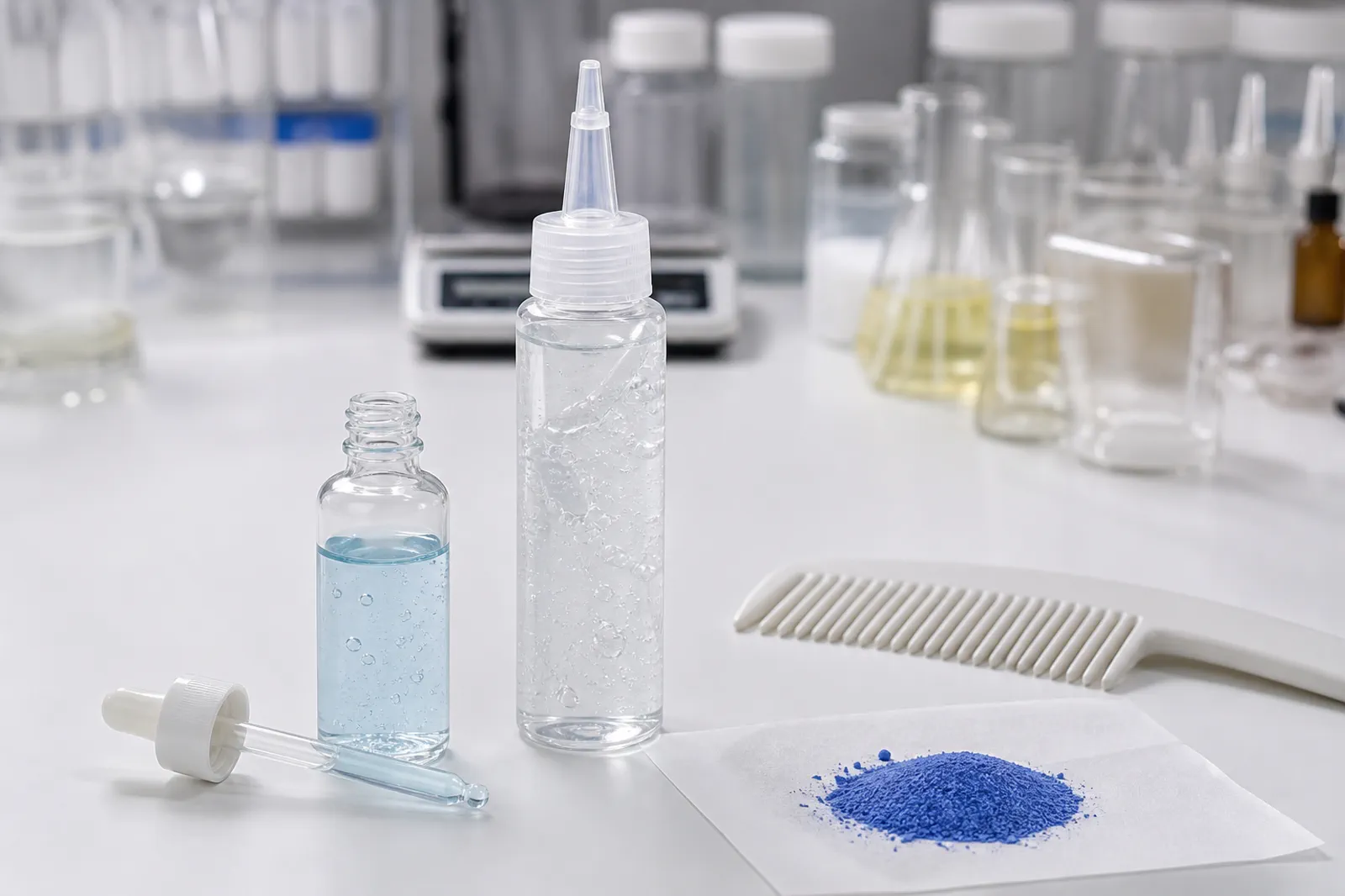
1. Same INCI line, two leave-on jobs
A face serum asks for elegance on cheeks and a film that does not pill under the next layer. A scalp serum asks for flow at the part, rinse-free comfort at the roots, and residue that does not look like gel in the hair. Those are different rheology and sensory contracts. Treat documented peptide lots as the active file, not as a finished product you can relabel. If the only change on the brief is the word ‘hair,’ you have not written a scalp formula. You have written a destination for complaints.
2. The vehicle that felt light on a face can be wrong at the roots
A tight carbomer or a high-film hyaluronic gel that looks luxurious on a cheek can sit greasy or stringy on a scalp and clog a nozzle. Gelling agents and thickeners are chosen for the full aqueous load and for how the user will dispense the mass — palm, dropper, or part-line tip. Electrolytes from a peptide concentrate still thin fragile networks; the scalp brief does not cancel that chemistry. Build viscosity for the applicator, not for a face-serum photograph.
3. The copper-peptide file does not become a density protocol
A kilogram GHK-Cu copper peptide is still a hydrophilic, coloured, chelator-sensitive cosmetic active. Its TDS talks process and appearance for that lot — not follicle pharmacology. Colour monitoring and cool-down still apply when you move the same lot into a scalp water. Do not raise the mass ‘for hair’ because a brochure used the word copper. Do not pair the lot with a strong chelator just because a face serum already did. Read this file again as if the chassis were new, because it is.
What buyers say
Buyer experience with this exact Mylo-Opt product. Educational content stays primary — this is not scientific proof.
Open the exact product page — Caffeine 1 kgI keep buying caffeine — great quality at a really good price!
4. Scalp roommates are a second brief, not a free add-on
Face copper-peptide waters often live with humectants and a quiet polymer. Scalp briefs arrive with caffeine, niacinamide, menthol stories, or essential-oil traces. Caffeine powder is a documented scalp-adjacent active with its own solubility and ionic load — it is not a reason to keep the face gel unchanged. Each roommate can move pH, salts, and preservation. Add one, keep a retain without it, and do not call the stack ‘the same GHK-Cu serum with extras.’
5. Fiber-first and scalp-first are not one fill
If the product is meant to travel down the shaft, you need slip and a different residue story than a root-only water. D-panthenol concentrate is a common fiber-side humectant with its own sensory tax; it does not turn a face peptide gel into a combing cream. Pick a hero zone. Hybrid ‘roots and lengths’ fills are a third architecture. They are harder to preserve and easier to over-claim. Clarity on the label reduces misuse more than a second peptide.
6. Pack, dose and process finish the fork
A face dropper that doses half a millilitre is a poor root tool. A nozzle that shears a fragile gel will look like a failed peptide. Cool-down addition of peptides still belongs after heat and after the polymer is decided — the scalp pack does not excuse an early dump into a hot mix. Preservation must survive daily opening at a bathroom sink, not only a bedroom dropper. If the face retain is stable and the scalp fill is not, you diagnosed the chassis, not the sequence.
7. Claims that survive a file — and those that do not
You can say this is a cosmetic leave-on for the scalp or for the face, built around a documented copper-peptide lot. You can say the vehicle was rewritten for flow and residue. You cannot say the serum grows hair, thickens follicles, or is ‘the same clinical copper as a face serum, therefore stronger on the scalp.’ You cannot copy a face use level onto a larger application area and call it equivalent exposure. If the brand needs a growth story, it needs a different evidence file than a cosmetic TDS. If it needs a pleasant root serum, write that chassis and stop there.