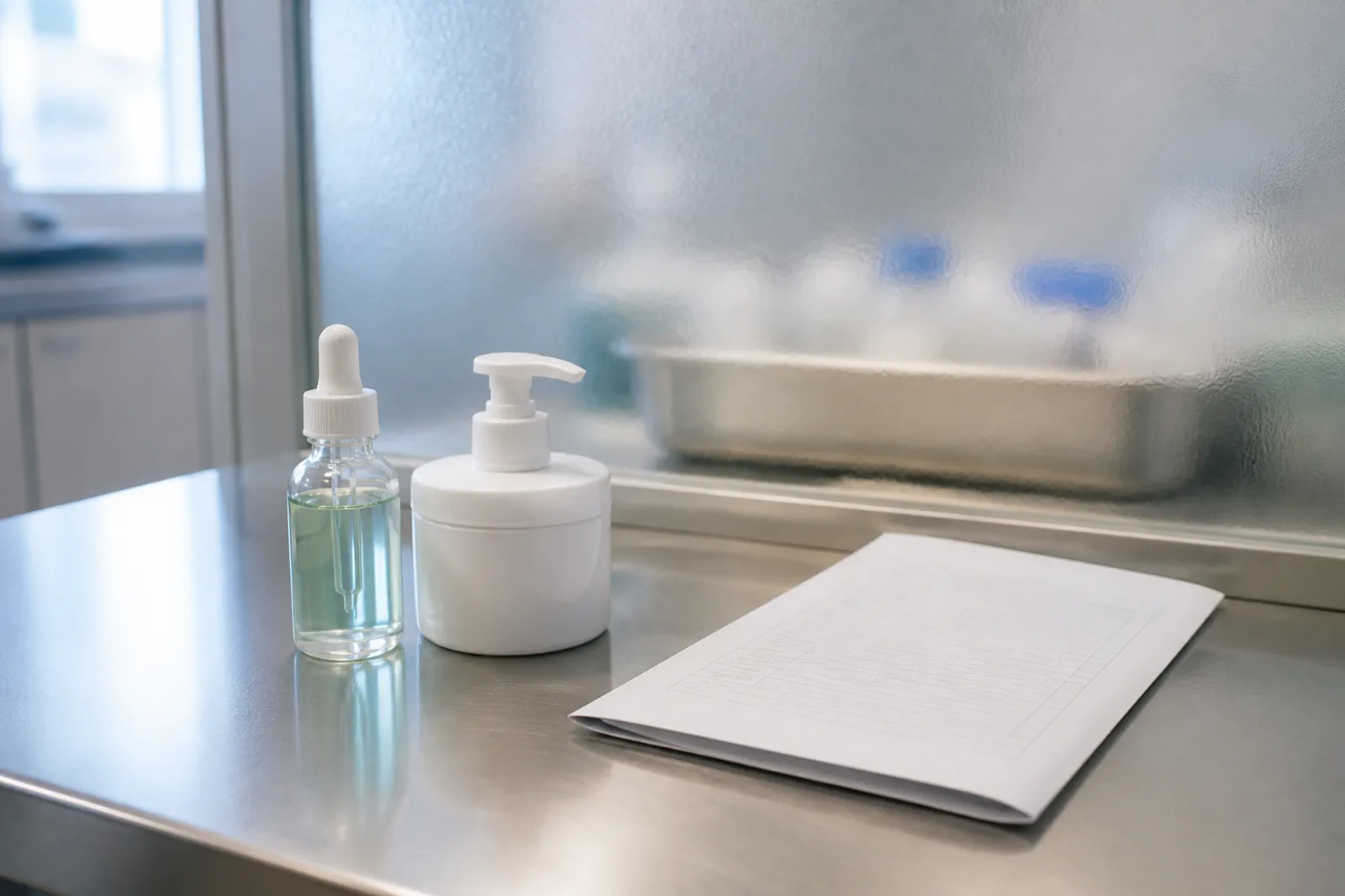
1. Write two product jobs before you write one INCI
Job A is a leave-on cosmetic: water, humectants, polymer, preservative, and a documented copper-peptide raw material, applied to intact skin. Job B is anything that assumes a breached barrier, a sterile field, or a device. Those jobs do not share a manufacturing file just because both bottles are blue. Browse the cosmetic peptide category as lots sold for topical cosmetics — sequence, solvent, appearance — not as anonymous ‘copper water’ for a tray. If purchasing ordered a serum concentrate and marketing later wrote ‘use with a roller,’ the brief changed after the batch was designed. That is a new product, not a usage footnote.
2. Preserved is not sterile — and the file will say which one you bought
A challenge-tested leave-on can be a well-made cosmetic and still be the wrong object for a procedure. Preservation limits organisms in a consumer pack under stated storage and use. Sterility is a different claim, a different process, and a different pack. Do not infer sterility from a clear gel, an airless pump, or a ‘clean’ story. Look at preservatives and antioxidants as the system that keeps a water product a cosmetic — not as a stamp that the fill is theatre-ready. If the TDS is silent on sterile manufacture, you do not have a sterile product. Silence is not a workaround.
3. The raw material is a cosmetic lot, not a clinic reagent
A GHK-Cu copper peptide sold as a bulk cosmetic active arrives with identity, appearance, and process language for leave-on formulas. That file does not become a procedure monograph because a thread mixed ‘topical’ with ‘needling.’ Do not transfer injectable or mesotherapy anecdotes onto this powder or onto a serum made from it. Dose, depth, and regulation are not on the cosmetic TDS. If your brief needs a procedure-grade material, you are no longer writing a MO-LAB cosmetic chassis — you are in a different quality system entirely.
4. ‘Compromised skin’ is a brief stop, not a folklore upgrade
Workshops use ‘compromised’ for sunburn, eczema flare, fresh exfoliation, open acne, or device tracks. Those are not one chemistry problem. They are reasons to stop treating the product as an ordinary leave-on until a clinician and a different file are in the room. A formulator can say: this chassis was designed for intact skin; we will not add a barrier-breach claim. A formulator cannot say the peptide will ‘heal’ a wound or that a preserved serum is acceptable on broken skin because a neighbour did it. If irritation or barrier damage is the question, stop the product. That is not a copper-uglies timeline and not a loading phase.
5. Process literacy still belongs to the cosmetic chassis
Even when the inbound question is medical-adjacent, the lab still has to put the lot into water without inventing a use level. Read incorporation notes for leave-on peptides for temperature, pH, and order — those lines do not license a new route of administration. Do not ‘make it clinic-strong’ by raising the peptide while skipping preservation work. Do not ‘make it safer for rolling’ by cutting the preservative. Both moves invent a third product with no file.
6. A peptide water is a nutritive cosmetic, not a closed vial
Copper-peptide serums are water products with organic load. Treat preservation of peptide-rich waters as part of the cosmetic job: the hydrate must remain a documented leave-on, not an opened beaker people dip tools into. Shared droppers, fingers in the jar, and ‘ampoule on the tray’ habits are contamination stories, not proof the peptide failed. If the pack cannot survive ordinary intact-skin use, fix the cosmetic system. Do not solve that by declaring the serum a procedure fluid.
7. What honest copy can say — and what it must not
You can say this is a cosmetic leave-on for intact skin. You can say the lot was not manufactured or documented as sterile. You can say the supplier file is silent on device use. You cannot say the serum is ‘safe to needle,’ ‘sterile enough,’ ‘clinic-grade because it is preserved,’ or ‘the same as a mesotherapy vial.’ You cannot give a rolling schedule or a reconstitution-for-injection story. If the brand wants a procedure SKU, that is a different development path. If the brand wants a face serum, keep the claim on intact skin and send personal medical questions to a clinician.