1. Appearance belongs to a specification, not to the internet
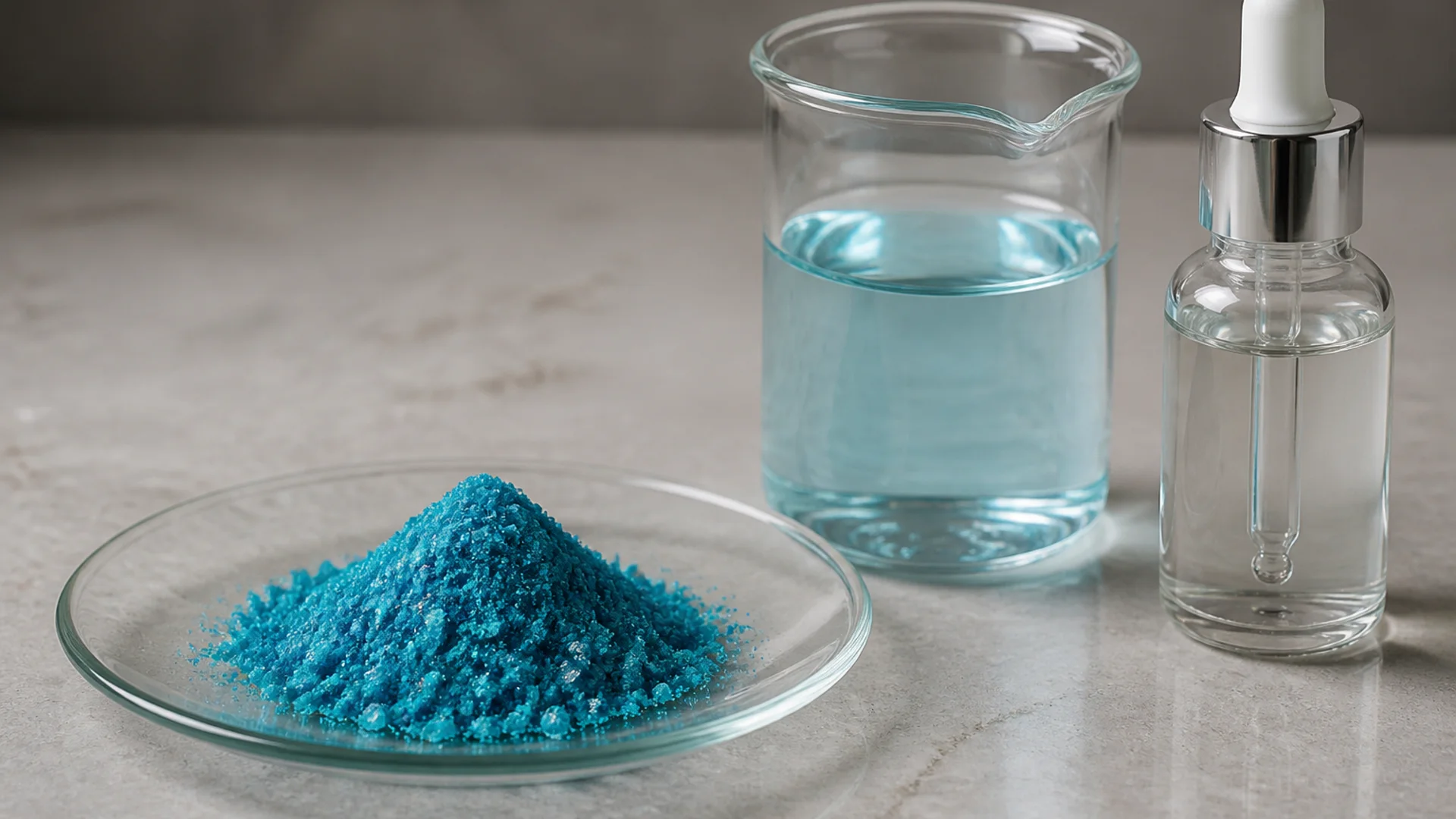
Cosmetic GHK-Cu lots are sold as powders, pre-dissolved liquids and finished formulas. Files disagree in language because they describe different objects: some powders are specified as blue or blue-green crystals; some solutions are specified as blue liquids; some powders are described as paler solids that produce a coloured solution. None of those sentences is a universal law of nature. Read the appearance line on the lot you purchased. The cosmetic peptide category contains more than one copper presentation; do not police all of them with one Instagram reference bottle.
2. A blue-green hue can be consistent with Cu(II) — that is all it proves
Copper(II) complexes often absorb in a way that looks blue or blue-green in water. Seeing that tint in a solution prepared from a documented GHK-Cu copper peptide can agree with “the complex is in the water.” It does not measure HPLC purity. It does not measure copper content. It does not measure how much peptide you put in the serum after dilution. Pale finished formulas are common when the addition rate is low, the path length is short, or other ingredients scatter light. Dark turquoise is not a certificate.
What buyers say
Buyer experience with this exact Mylo-Opt product. Educational content stays primary — this is not scientific proof.
Open the exact product page — Low-MW hyaluronic acid 1 kgWe only buy low-molecular hyaluronic acid from you. Quality matters for the cosmetics we make.
Open the exact product page — Low-MW hyaluronic acid 1 kgLow-molecular hyaluronic acid works for our higher-end cosmetics. Quality is high, prices are reasonable. Thank you!
3. Intensity cannot quantify purity or dose
Beer’s law needs a defined path length, a calibration, and a wavelength. A shopper holding two bottles in a bathroom does not have that experiment. Haze, bubbles, dyes, botanical tints, and amber glass all cheat the eye. Do not rank vendors by saturation. Do not infer that a paler serum “has less peptide” than a darker one from another brand. Those products are not the same matrix.
4. Powder, solution and serum are three photographs
Compare powder to the powder specification, solution to the solution specification, bulk to your retained control — not powder to a competitor’s finished dropper. A kilogram powder can look vividly coloured while a dilute leave-on looks almost water-white. That is dilution and optics, not automatically fraud. Conversely, a very blue finished gel may contain colorants or a different copper salt. Ask the INCI and the file.
5. A colour shift is a troubleshooting signal
If a batch moved from the intended blue-green toward green-brown, grey, or haze after process or storage, write down pH, heat history, chelators, metals, and light. That is the same discipline as other oxidation-sensitive actives: protecting actives from light and air is process control, not a percentage copied from a marketing page. Do not repeat unsupported “X% degraded in Y days” figures from blogs. Measure what you can: appearance versus retain, pH, odour. Then read the lot file for incompatibility notes.
6. Light, pH and packaging change what you see
Window sills and clear glass advertise colour; they also advertise light exposure. Headspace and pumps add oxygen over time. pH shifts can change copper complex appearance without proving the product is “fake.” Pairing with a film-heavy gel or with low-MW hyaluronic acid can change scatter and therefore perceived tint. Photograph retains under the same lamp. Do not judge Monday bulk against Friday Instagram.
7. What to verify before you say anything quantitative
INCI. Appearance specification. Assay method if provided. Recommended addition stage — incorporation notes for peptides still matter so you do not cook a colour change into the batch and then blame the molecule. Storage. If those lines are missing, you cannot use colour as a proxy for them. You can only refuse to overclaim.
8. Claims that colour cannot carry
Authenticity. Concentration. Clinical performance. “More copper.” “Oxidised, therefore dangerous” without a real investigation — and this page is not the copper-uglies safety article. Colour can support “matches specification” or “does not match retain.” Everything else needs a method. If you need a number, it lives on the COA, not in the hue.