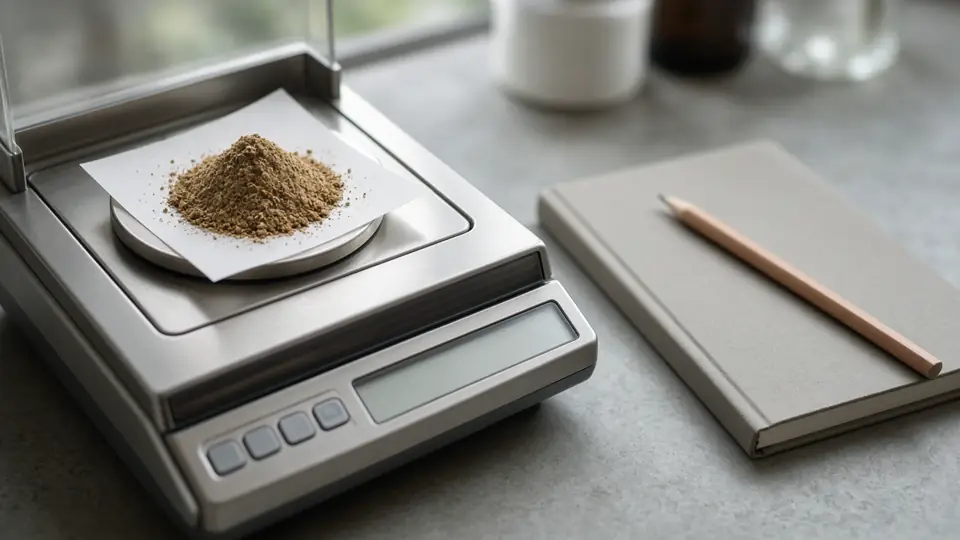
1. Stop writing a plant nickname as a finished percent
If the formula sheet already says ‘green tea 2%’ and nothing else, the weigh was invented in marketing. Open the dry botanical extracts shelf as lots with files, not as a herb percentage. Write three questions before the scoop: is the number plant-to-extract ratio, extract solids, or a marketed plant equivalent that this file never promised?
2. Name the weigh object: ratio, solids, or a brochure line
A witch-hazel dry extract and a green-tea dry extract can share a plant story and still disagree on what 1.00 g on the pan represents. One file speaks in native extract. Another speaks in a documented dry native or a carrier-inclusive as-is mass. A third brochure line talks as if the powder were the plant. Those are not interchangeable. Copy the field. Do not average them.
What buyers say
Buyer experience with this exact Mylo-Opt product. Educational content stays primary — this is not scientific proof.
Open the exact product page — Witch hazel dry extract 1 kgYou can use dry witch hazel extract as a supplement — it works pretty well.
3. The only allowed numbers live on this lot’s TDS/COA
If the file is silent on ratio, you do not invent one from a blog or from a sister SKU. If the file lists a carrier, that carrier is part of the as-is weigh. If the file lists solids, that is the conversion — not a strength claim. Botanical extracts as a family do not share one dose arithmetic. Sister lots are not a calculator.
4. Do not reopen chassis, grind identity, or sediment
Which commercial form to requisition is the chassis article. Whether the brown powder is even an extract is the identity article. What sank after hydration is sediment. Here the powder is already the right object and the brief is already a water or cream chassis. The only remaining question is which column on the file owns the pan.
5. A retain is one basis, one pan
Do not ‘compare’ a ratio weigh and an as-is weigh in the same beaker and call the darker gel a quality failure of the plant. You weighed two different stories. If the brand wants a plant-equivalent claim, that claim is a documentation problem, not a scoop problem. Notes on using dry extracts in serums and toners confirm a SKU family exists — they do not write your conversion.
6. What honest copy can say
You can say this lot’s file named the weigh basis, the pan followed that field, and the chassis was already chosen. You cannot say a dry extract is ‘2% plant’ because a competitor’s dropper said so. You cannot publish a universal green-tea coefficient. If two textures need two bases, that is two specifications.