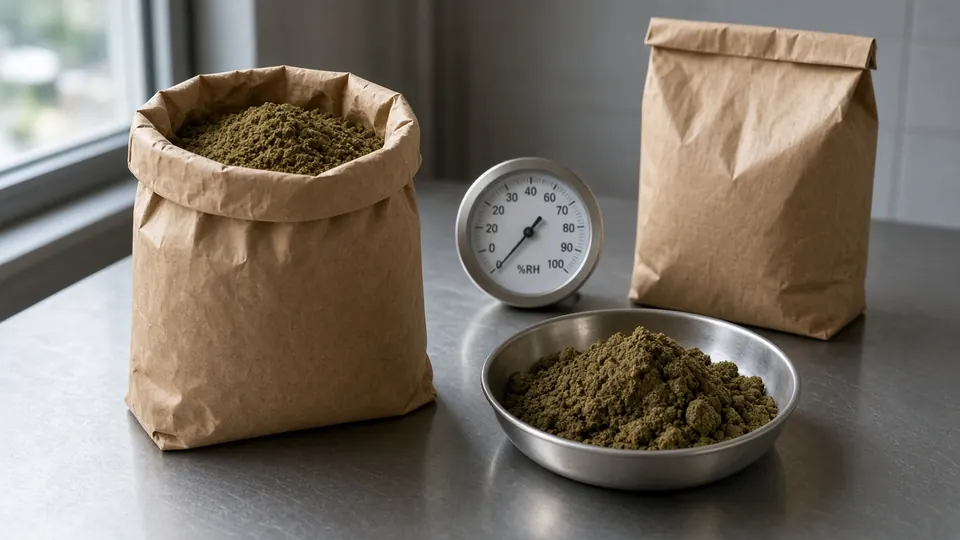
1. Write when the bag was opened, not a new plant coefficient
If the brief already named the weigh basis, the next job is to keep that basis attached to this lot. An opened kraft sack on a humid bench is a different object from the sealed twin in the same shipment. Walk Dry botanical extracts as lots with storage notes, not as a slogan that ‘powders are dry’. A pan that gained mass overnight is not proof the supplier changed the plant ratio.
2. This is not the ratio-versus-solids page
The 14 September article decides whether you weigh a plant ratio, a solids line, or a marketed percent once the form is chosen. Stay here when that decision is already written and the pan still disagrees with the file. Do not steal that dose-basis tree. Do not ‘fix’ humidity by inventing a new coefficient from a sister SKU.
3. This is not grind identity and not sediment
Brown dust is not automatically a dry extract — that identity fight is already published. Sediment in a finished water is another page. Stay here when the powder was already classified as a dry extract and the only new fact is that the opened bag no longer matches the incoming weigh. Witch hazel dry extract 1 kg is a documented hygroscopic powder on this aisle — it is not a licence to skip a closed container between weighings.
What buyers say
Buyer experience with this exact Mylo-Opt product. Educational content stays primary — this is not scientific proof.
Open the exact product page — Witch hazel dry extract 1 kgYou can use dry witch hazel extract as a supplement — it works pretty well.
4. Bind two masses to this lot before anyone edits the formula
Mass A: the sealed pack on incoming goods. Mass B: the same lot after the bag sat open on this bench. If B is higher and the appearance is caked, stop rewriting the brief. Green tea dry extract is a second documented powder with the same storage job — it is not a different mathematics. If the TDS is silent on loss on drying for this shipment, you do not invent a moisture number from a catalogue.
5. Photograph the pan against the sealed twin before buying a new sack
Cup A: powder from the sealed bag, weighed promptly. Cup B: powder from the opened bag after a documented hold. If A matches the file and B does not, the purchasing rewrite is humidity, not a new extract. The botanical extracts hub is where you confirm this is still a dry-extract SKU — it is not a place to shop a ‘less hygroscopic plant’. Close the bag. Do not leave a hygroscopic pan as the workshop’s shared spoon jar.
6. What honest copy can say
You can say this lot was classified as a dry extract, the dose basis was already named, and the pan walked after the bag sat open. You cannot say witch hazel ‘does not take humidity’. You cannot publish a universal moisture allowance. Notes on using dry extracts in serums and toners confirm a documentation family exists — they do not write your incoming-mass diagnosis. If the brief needs a stable incoming weigh, keep the bag closed or stop using the open-sack mass in the batch sheet.