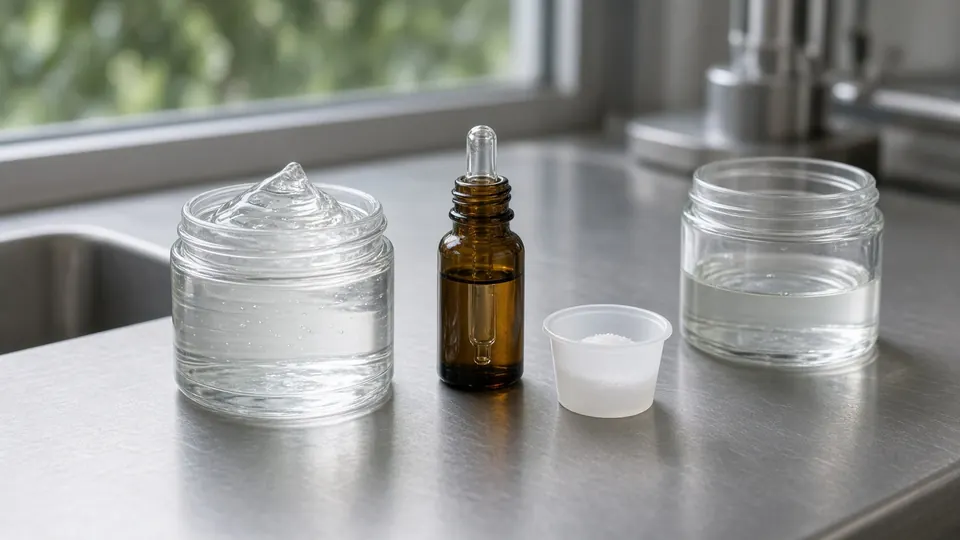
1. Write the hour the peak fell, not a new polymer percent
If the brief is a standing water gel, photograph the blank before anyone opens the polynucleotide. Walk the gel formers aisle as lots with electrolyte notes, not as a slogan that ‘PDRN likes carbomer’. A slurry that never peaked is yesterday’s hydration page. A gel that peaked and then poured is a post-addition event. Those clocks are not interchangeable, and neither is proof the sequence is ‘dead’.
2. This is not the PDRN-plus-hyaluron cloud page
The 13 September article times opalescence after a DNA-fragment lot entered a clear HA gel. Stay here when the polymer is an acrylate that already stood and the failure is viscosity, not Tyndall haze. Do not steal that optical tree. Do not diagnose ‘same polynucleotide, therefore same salt’ when the blank was HA and this blank is carbomer.
3. This is not a slurry that never gelled
The 6 September carbomer page is fish-eyes, alkali craters, and a mass that never built. Stay here when cup A — polymer blank after neutralize — already holds a peak. If cup A is water, you are on the wrong article. Doubling Carbomer 1 kg after a standing gel collapsed does not rewrite the polynucleotide’s counter-ions. It often turns an elegant gel into a sticky paste that still thins on the next addition.
What buyers say
Buyer experience with this exact Mylo-Opt product. Educational content stays primary — this is not scientific proof.
Open the exact product page — Carbomer 1 kgBought carbomer to make a shower gel. Followed the instructions. The carbomer thickened the water phase nicely. I'd shop here again.
Open the exact product page — Xanthan gum 1 kgShampoo recipe: I cool a soap-nut decoction (around 300 ml), add a teaspoon of baking soda, dissolve essential oils in polysorbate 20 (I like citrus and mint — hair stays clean longer), mix that into the decoction and add a pinch of xanthan gum. I whip it with a regular immersion blender, not a little cream mixer. The longer I blend, the thicker the shampoo. It keeps in the fridge for two weeks.
4. Open the PDRN lot and the polymer file as two objects
A documented PDRN 1 kg lot is a cosmetic concentrate with its own solvent, conductivity story, and appearance on this shipment — not a nickname for any ‘DNA serum’. The polymer file names hydration, neutralization, and electrolyte sensitivity. If either sheet is silent on salts, you do not invent a collapse coefficient from a sister SKU. Pair a retain of the standing blank against a retain after the polynucleotide at the process temperature this file allows.
5. Split the retain before anyone buys more acrylate
Cup A: standing carbomer blank. Cup B: blank plus polynucleotide. Cup C: a salt-tolerant fork on the same brief. xanthan gum is a process alternative when the acrylate will not tolerate this lot’s ions — it is not a slogan that ‘natural gums never thin’. If A stands and B pours, stop blaming the polymer milligrams. Photograph the three cups before purchasing rewrites the SKU.
6. What honest copy can say
You can say this gel’s peak was documented first, this polynucleotide lot was classified as a cosmetic concentrate, and collapse was timed to addition against a standing blank. You cannot say PDRN ‘does not thin carbomer’. You cannot publish a universal acrylate-to-polynucleotide ratio. Notes on a PDRN polynucleotide serum confirm a documentation family exists — they do not write your salt diagnosis. If the brief must keep an acrylate peak and this pair will not, change the polymer family or delete the viscosity claim. The polynucleotide category is a shopping aisle after the files agree, not a repair kit.