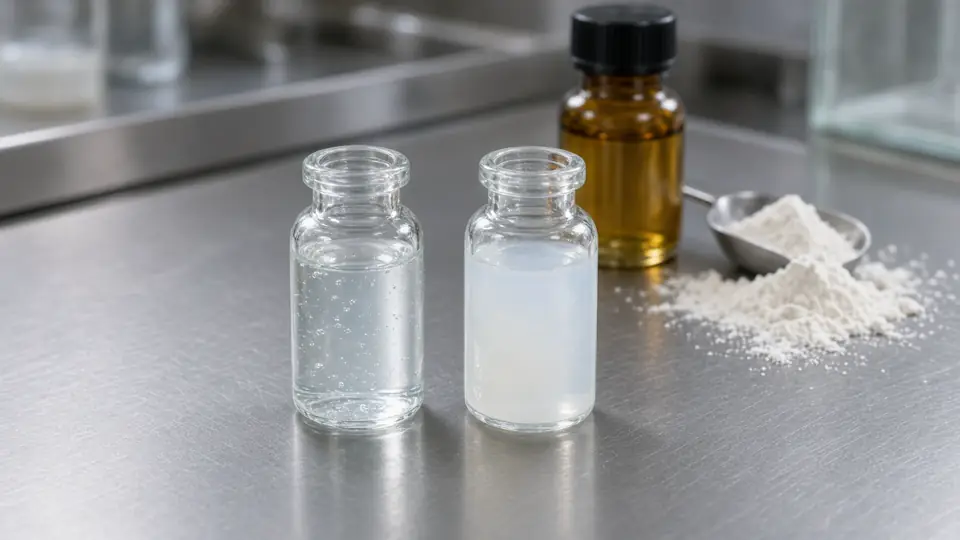
1. Write ‘clear, then cloudy’ before you write a brand
If the HA water was already hazy, the PDRN lot is not the first suspect. If it cleared and then clouded on addition, stay on that moment. Open the polynucleotide category as lots with files, not as a clinic nickname. A photo of milkiness is not an assay of the polynucleotide.
2. Name both incoming objects
A PDRN 1 kg lot may arrive as powder or a pre-dissolved cut, with its own salts, solvent and appearance line. A low-MW hyaluronic acid lot has its own solids, pH habit and clarity window. They are two passengers. Hyaluronic acid actives as a family do not share one optical promise. Copy INCI, recommended stage, and appearance from both TDS/COA pages. Silence about ‘will stay clear with PDRN’ is a gap, not a blessing.
What buyers say
Buyer experience with this exact Mylo-Opt product. Educational content stays primary — this is not scientific proof.
Open the exact product page — Low-MW hyaluronic acid 1 kgWe only buy low-molecular hyaluronic acid from you. Quality matters for the cosmetics we make.
Open the exact product page — Low-MW hyaluronic acid 1 kgLow-molecular hyaluronic acid works for our higher-end cosmetics. Quality is high, prices are reasonable. Thank you!
3. This is not the pairing page
The published HA+PDRN guide asks whether those roles belong together. This page assumes someone already poured. Do not reopen ‘should we combine them’. Do not reopen PDRN-in-serum placement. The only question is why this clear gel went optically dirty after this addition.
4. Salts, solids, pH walk, air, and order
Suspects you can actually write down: counter-ions on the polynucleotide, HA solids already high, a pH walk after addition, undissolved powder, or air beaten in on a thick gel. Gel formers in the same water can hold haze that a thin toner would settle. Do not declare a molecular-weight class guilty without the HA file in front of you. Do not declare the PDRN ‘degraded’ because the gel looks opalescent — opalescence is not an identity assay.
5. Decide whether clear was ever the specification
Some polynucleotide waters are sold as slightly opalescent. If the brief demanded a water-clear toner, that lot may be the wrong object even when the file is honest. Split the chassis: HA only, PDRN only, both, neither. Same pack, same light. If A and C cloud the same way, you have a polynucleotide-in-this-water event, not proof the HA ‘rejected’ it. If only C clouds, the pair is the event.
6. Keep clinic polynucleotide stories off the dropper
Injectable or mesotherapy PDRN is a different manufacturing and legal object. Do not transfer those anecdotes, doses, or ‘repair’ stories onto a preserved cosmetic gel. A leave-on water is judged as a leave-on water. If the brief wants a procedure product, write that brief separately. Read polynucleotide serum notes only to confirm a cosmetic SKU family exists.
7. What honest copy can say
You can say two lots were read, a retain set was kept, and the optical change was timed to an addition. You cannot say ‘PDRN always clouds HA’ or ‘low-MW HA always stays clear’. You cannot publish a clinic repair claim on a cosmetic gel. You cannot use haze as proof the polynucleotide is stronger or weaker.