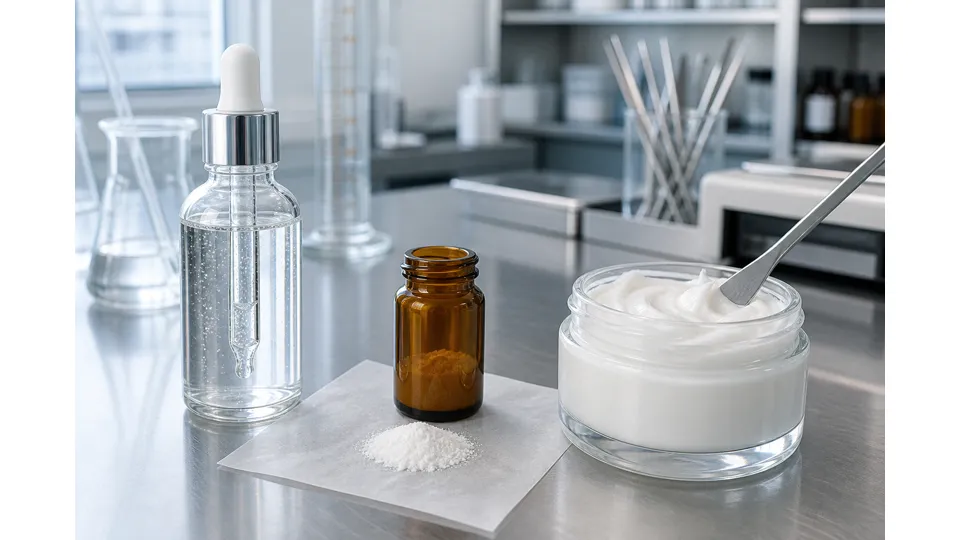
1. The name on the bottle is not a Franz-cell result
“Serum” and “cream” are sensory and architectural nicknames. They do not encode stratum-corneum recovery data for your peptide. Hydrophilic sequences are poor passengers through intact barrier in ordinary leave-on use; that problem exists in both a watery gel and an oil-in-water cream. Do not advertise a dropper as a delivery upgrade. If you need measured permeation, you measure that chassis. Cosmetic peptide raw materials should be chosen from a documented file, not from a format slogan.
2. In both formats the peptide usually still sits in water
Unless you bought a supplier-documented oil-dispersible form, the sequence is introduced into the aqueous phase or a cool-down premix. A cream’s oil phase is for emollients, waxes, and sensory cushion. It is not a secret tunnel that “pulls peptide through.” A SNAP-8 concentrate added to a lotion still arrives with its water, glycols and salts. Those carriers change the cream’s water phase the same way they change a serum. Read the INCI of the purchased material before you decide the format will rescue a bad file.
What buyers say
Buyer experience with this exact Mylo-Opt product. Educational content stays primary — this is not scientific proof.
Open the exact product page — Xanthan gum 1 kgShampoo recipe: I cool a soap-nut decoction (around 300 ml), add a teaspoon of baking soda, dissolve essential oils in polysorbate 20 (I like citrus and mint — hair stays clean longer), mix that into the decoction and add a pinch of xanthan gum. I whip it with a regular immersion blender, not a little cream mixer. The longer I blend, the thicker the shampoo. It keeps in the fridge for two weeks.
3. What a serum is actually good at
A light aqueous gel spreads far, layers under other products, and can stay optically honest. It also concentrates preservation risk in high water activity and can pill under sunscreen if the polymer and humectant load is greedy. The thickener aisle for serums is a real design choice, not an afterthought: electrolytes from peptide blends can drop viscosity overnight. Choose a serum when the brief wants fast spread, a dropper or airless, and a water-phase story — not because you believe water “penetrates.”
4. What a cream is actually good at
A cream buys cushion, slower evaporation, and a barrier-oriented sensory. It also buys an interface that can split, grain, or feel occlusive. An Olivem 1000 emulsifier (or any other documented system) has to carry the full oil phase plus late extras. Occlusion can change how a film feels and how much product people use; it is not proof of better peptide delivery. Choose a cream when the user goal is comfort and residue, or when the peptide is a supporting actor beside emollients — not as a workaround for a serum that failed rheology.
5. Preservation and process differ even when the INCI of the peptide does not
A serum challenge is not a cream challenge. Oil, waxes, and a different water activity change the micro job. Late-stage peptide incorporation still belongs after necessary heat in both formats; dumping a heat-sensitive blend into a hot emulsion because “cream is cooked anyway” is a process error. Cool the bulk to the supplier window. A xanthan gum slurry hydrated in water before emulsification is a cream decision; the same gum in a clear serum is a different ionic conversation. Do not copy a serum preservative template into a rich jar.
6. People do not apply the same grams
A dropper serum is often under-applied. A cream is often over-applied in winter. Surface dose is part of any honest “which is better” answer. A sticky serum that users hate will lose to a bland cream they finish. Sensory is not vanity: it is compliance. If the goal is eye-contour, a dedicated light gel may be easier to place than a rich cream that migrates. That is use geometry, not proof that serum molecules travelled farther.
7. Pick the chassis that matches the job
Want layering under SPF and a water-phase hero? Serum, with a polymer that survives the peptide carriers. Want night cushion and less tightness? Cream, with an emulsifier that survives cool-down extras. Want both stories in one SKU? You are designing a hybrid, which is a third architecture — not “serum power inside cream marketing.” Write the brief as: site, sensory, packaging, preservation, and which peptide file you actually hold. Then build that. Do not rank formats by a blog permeation cartoon.