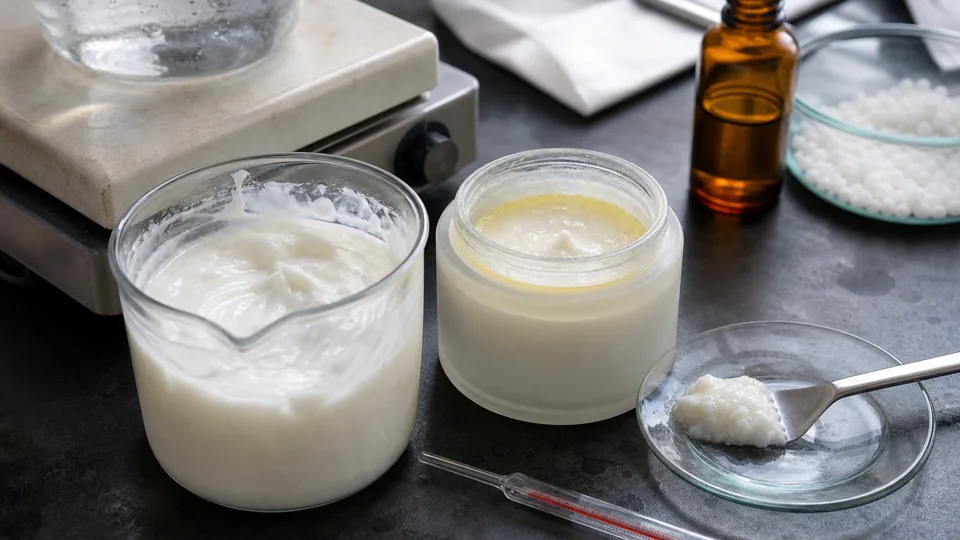
1. Name the defect before you change the formula
“It split” is not one observation. A watery ring on the surface, a yellow oil film at the rim, grainy wax on the spatula, and a cream that looks aerated but still holds together are different events. Photograph the jar from above and from the side under the same light. Note whether liquid is water-like or oily, whether solids have settled, and whether the bulk is still a cream or has collapsed into lotion plus serum. Only then decide which lever to touch. Many failures blamed on cosmetic emulsifiers are actually cooling-rate, oil-phase load, or a cool-down ingredient that never belonged in a finished emulsion.
2. Hot phases that are not actually at the same temperature
A classic O/W process asks the oil phase — including waxes and the primary emulsifier — and the water phase to meet while both are fully fluid. If one beaker is still cloudy with unmelted structure and the other is already cooling at the wall, you do not have an emulsion; you have a partially dispersed wax slurry. Measure the mass, not the hot-plate setting. A thermometer against the glass wall is not the batch temperature. When the two phases finally combine, a large temperature gap can shock fatty alcohols into crystals that later feel grainy and can seed oiling-off as the cream sets.
3. The emulsifier has to be in the phase the TDS describes
Read the supplier sheet for the exact grade in front of you. Some systems are designed to melt into the oil phase; others hydrate in water; a few are used as ready blends. An olive-derived liquid-crystal emulsifier does not behave like a self-emulsifying glyceryl stearate blend, even if both make a white cream in a demo. If the material was added to the wrong phase, or added after the emulsion had already started to set, overnight syneresis is a reasonable outcome. Do not copy a percentage from a blog post. The working range, melting behaviour and electrolyte notes belong to that TDS/COA.
What buyers say
Buyer experience with this exact Mylo-Opt product. Educational content stays primary — this is not scientific proof.
Open the exact product page — Squalane 1 kgFirst time trying squalane and I was honestly impressed. Used it without massage so far, just instead of cream after washing my face. Moisturizes well and soaks in pretty fast. Perfect for winter — radiators dry my skin at home and it's freezing outside. No dryness or flaking after using it. Super economical too. I'll try it with a gua sha massage sometime.
Open the exact product page — Xanthan gum 1 kgShampoo recipe: I cool a soap-nut decoction (around 300 ml), add a teaspoon of baking soda, dissolve essential oils in polysorbate 20 (I like citrus and mint — hair stays clean longer), mix that into the decoction and add a pinch of xanthan gum. I whip it with a regular immersion blender, not a little cream mixer. The longer I blend, the thicker the shampoo. It keeps in the fridge for two weeks.
4. Oil-phase load is a structure problem, not a richness problem
Formulators often add “a little more oil for a richer feel” after the emulsion is already formed. That extra lipid has to be solubilised into an existing droplet population. If the interfacial film is already occupied, the surplus appears later as a rim of oil. Lightweight esters and squalane are useful oil-phase components, but they still count as oil. Rebuild the oil phase as a complete list, then ask whether the emulsifier system was chosen for that list — not for the original lighter lotion. Matching an emulsifier to the rest of the formula is cheaper than chasing oil-off with more polymer.
5. Cooling rate can break a network that looked perfect while hot
While the batch is hot, droplets move and the fatty-alcohol network is still forming. Fast cooling on a cold bench, or a sudden drop when a small beaker is moved onto a metal table, can lock in a coarse structure. Slow, mixed cooling usually gives a more uniform set, but “slow” is not a universal time — it depends on batch size, vessel and the specific emulsifier. If the cream looks glossy in the beaker and then weeps water after filling, compare a retained hot sample that was cooled with stirring against a jar that was filled and left still. The difference often points to process, not to a missing miracle ingredient.
6. Water-phase polymer is support, not a repair kit
A gum or acrylic thickener can hide a weak emulsion for a day and then release serum as the network relaxes. Hydrate the polymer fully before emulsification when the TDS allows it, and do not sprinkle extra polymer into a finished cream to “hold the oil.” If viscosity collapses after an electrolyte-rich active is added on cool-down, the polymer — for example xanthan gum — may be the part that changed, while the droplets were already poorly covered. Test the chassis without the late active, then with it, before you replace the emulsifier.
7. Preservation and cool-down extras change the environment
Preservative solvents, organic acids, fragrance, and ceramide dispersions are not invisible. They can shift pH, add oil, or introduce salts after the emulsion is already formed. Design the preservative system with the water phase, then confirm the finished pH against both the emulsifier sheet and the preservative sheet. A cream that splits only after the preservative is added is giving you the diagnosis. Appearance is not a substitute for a properly designed challenge test of the filled product.
A bench workflow that wastes less oil phase
Keep a retained control of the emulsion before cool-down extras. Change one variable: phase temperatures, homogenisation time, cooling with or without stirring, oil-phase composition, or the late-add. Fill the same packaging you intend to sell, not only a glass beaker. Record pH, appearance and a simple spatula test after processing, after rest, and after a modest temperature cycle if your lab uses one. If the defect repeats at the same step, you are no longer guessing. You are investigating a specific interaction — which is the only place a real fix usually lives.