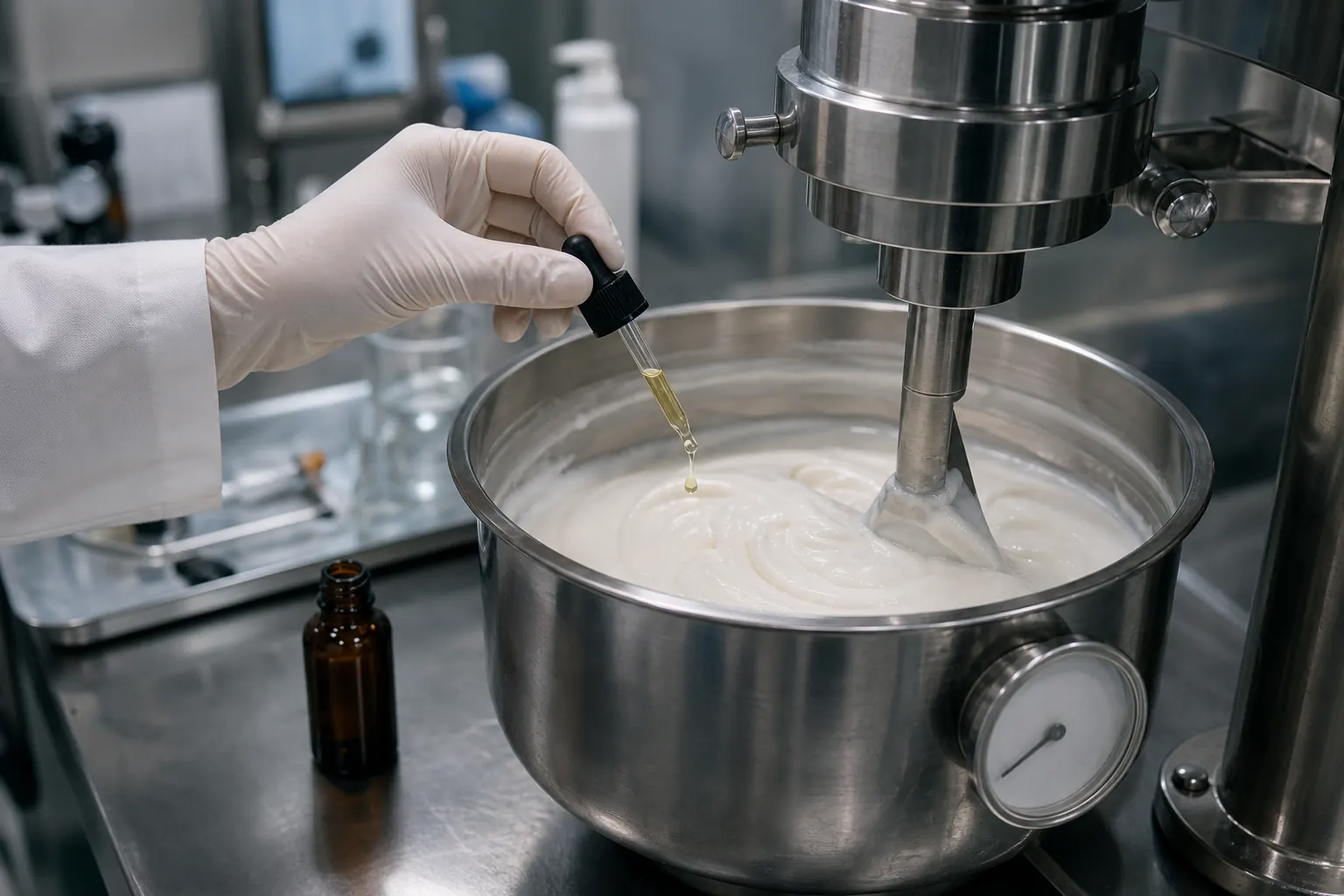
1. Write the process step before you write the category number
Leave-on versus rinse-off is a file you already have. Today’s ticket needs a different cell: cool-down, hot oil phase, or a lipid premix added after the emulsion exists. Browse documented essential-oil lots as concentrates with a recommended addition temperature and a volatility line — not as perfume you dump wherever the kettle is free. If the TDS is silent on process temperature, you do not have a step. You have a purchasing question. Do not invent a hold because a forum said ‘oils like heat.’ Heat what the emulsifier file requires; add the volatile concentrate when that job is over, unless the lot explicitly wants the oil phase.
2. A familiar floral is still a late guest if the sheet is silent on heat
Workshops treat lavender essential oil as friendly enough to survive a long hot hold. Friendly is not a process temperature. If the lot’s file allows cool-down addition, that is usually the honest room: the O/W interface already exists, the batch is no longer a naked fat, and you are not stripping the top note into the extractor hood. If you add it because ‘lavender always goes in the oil phase,’ you wrote a habit, not a ticket. This is not a category calculation and not a leftover-oxidation story. It is which clock the cream is on when the vial is opened.
What buyers say
Buyer experience with this exact Mylo-Opt product. Educational content stays primary — this is not scientific proof.
Open the exact product page — Jojoba oil 50 mlJojoba oil helped me fade stretch marks after I had the baby.
Open the exact product page — Jojoba oil 50 mlI tell people to get the German-made jojoba oil — the quality is solid.
Open the exact product page — Lemon essential oil 10 mlI add lemon essential oil to my hair rinse.
Open the exact product page — Lemon essential oil 10 mlI love the lemon smell — I drop the essential oil into soap, creams, and shampoos.
Open the exact product page — Lemon essential oil 10 mlI'd point people with really split ends toward lemon essential oil — after a while the ends look more put together.
Open the exact product page — Lemon essential oil 10 mlBought lemon essential oil and I didn't expect to like the smell this much.
Open the exact product page — Lemon essential oil 10 mlI buy lemon essential oil pretty often and add it to my hair rinse.
Open the exact product page — Lavender essential oil 10 mlI only use lavender oil inside the cabinets: I made sachets and refresh them now and then with a couple of drops of lavender. That's my moth prevention. The lavender sachets are the favorites in the kitchen cabinets — one on every shelf.
Open the exact product page — Lavender essential oil 10 mlLavender essential oil helped me get rid of dandruff. I'm really pleased. Thank you!
Open the exact product page — Lavender essential oil 10 mlMy esthetician told me to put lavender essential oil in a hair mask.
Open the exact product page — Lavender essential oil 10 mlFor me, lavender essential oil is just a strong anti-stress thing.
Open the exact product page — Sweet orange essential oil 10 mlSmells like fresh orange. From the texture you can tell it's made from natural ingredients. You just can't tell the exact percentage mix.
Open the exact product page — Sweet orange essential oil 10 mlFinally found the smell of a freshly peeled orange! Super!!! I'd buy it again.
Open the exact product page — Sweet orange essential oil 10 mlOrange oil is really fragrant and feels right on the nose right before New Year.
3. A citrus top note is a poor passenger in a long hot fat
Putting lemon essential oil into a 70–80 °C triglyceride hold is a volatility and heat-history decision, not a daylight-phototoxicity decision and not a drop-count. The cream may still be legal in its category and still lose the note you paid for, or pick up a cooked smell that people will later blame on ‘a bad citrus lot.’ If the TDS wants the oil phase, write the shortest honest hold. If it does not, wait for cool-down. Do not run a hot-kettle experiment to settle a sun question. Two files. Two clocks.
4. A confectionery citrus still needs a vessel, not a habit
Weighing sweet-orange essential oil into a small lipid beaker can make a repeatable premix. That beaker is not yet the cream. Pouring the premix into the hot oil phase, into the cool-down emulsion, or into a leftover jar ‘to use it up’ are three different tickets. Familiar smell is not a process instruction. If the same premix later goes into a wash, you also changed the finished product — which is the category page, not this one. Here the only question is which step of this O/W cream receives that beaker.
5. A wax-ester premix is a scale trick, not a kettle licence
A jojoba premix is a weighing convenience for a small, terpene-rich addition. It does not rewind an oxidised leftover, and it does not tell you to empty the beaker into the hot fat ‘so the wax ester carries it.’ The premix still arrives at the step the cream can accept: usually cool-down once the emulsifier has done its hold. If you build the premix on Monday and add it on Friday, you have written an opening-and-storage protocol — a different leftover page. Today, write the minute the premix meets the emulsion.
6. The chassis writes the window; the vial does not
Look at the emulsifier aisle as the object that actually owns the hot hold and the cool-down curve. A liquid-crystal system that needs a long 70 °C hold is a bad room for a terpene concentrate unless the EO file explicitly wants that heat. A system that finishes early still needs a written addition temperature, not ‘when it looks creamy.’ Do not use the emulsifier percentage as a substitute for a process step. Do not cut the oil ‘to make the kettle safer’ and then pour the rest in later as a third, undocumented product.
7. What the process card must show — and what it must not
You can say the cream is an O/W leave-on and the essential oil was added at cool-down, or into the oil phase, or as a premix at a named temperature. You can say the lot file was silent on the step. You cannot print an IFRA maximum on this page. You cannot convert a few drops into a percent. You cannot call a cooked citrus note ‘oxidation of the opened bottle’ without smelling the retain. Category, dilution folklore and leftover oxidation stay on their own URLs. This page only refuses to let a legal vial hide an illegal kettle habit.