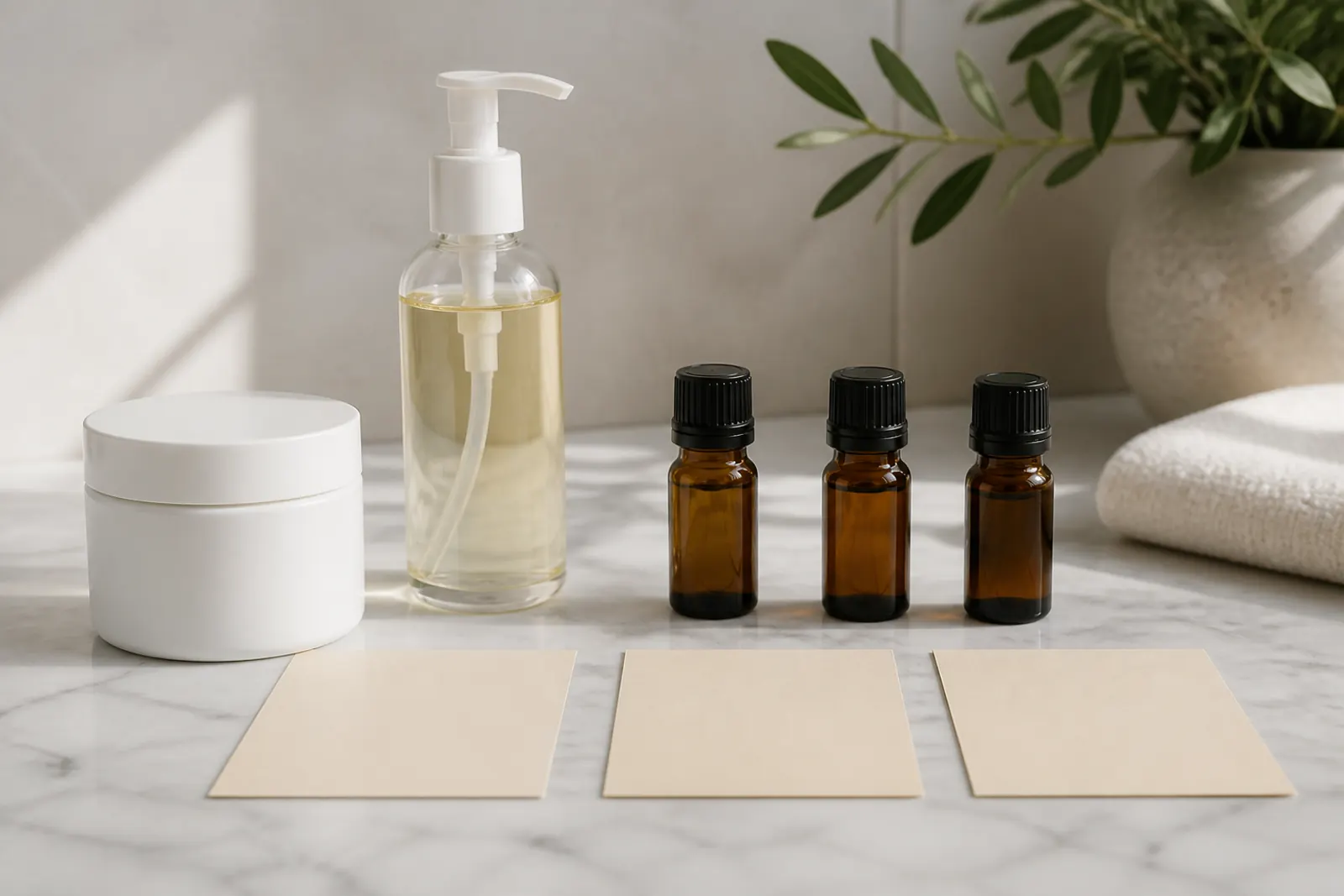
1. Write the product class before you open the vial
Is this a leave-on face cream, a body lotion, a rinse-off cleanser, or a hair wash? Those are different IFRA product categories even when the INCI of the oil is identical. Browse the essential-oil category as documented lots with a composition file — not as a flavour rack you dose by habit. If purchasing bought a vial ‘for the shower line’ and marketing later put it in a day cream, the category changed after the PO. That is a new calculation, not a footnote.
2. A leave-on face job is the stricter neighbour of the same Latin name
A lavender essential oil lot is a useful teaching case because it is the vial people treat as universally gentle. Gentle is not a category. A leave-on face cream sees longer contact, a different application area, and a different IFRA class than a rinse-off wash. The dilution article on this site already said ‘a few drops’ is not a specification. Today’s sentence is earlier: which class are you even calculating for? If the file is silent on the finished-product category, you do not have a number. You have a documentation gap.
What buyers say
Buyer experience with this exact Mylo-Opt product. Educational content stays primary — this is not scientific proof.
Open the exact product page — Jojoba oil 50 mlJojoba oil helped me fade stretch marks after I had the baby.
Open the exact product page — Jojoba oil 50 mlI tell people to get the German-made jojoba oil — the quality is solid.
Open the exact product page — Lemon essential oil 10 mlI add lemon essential oil to my hair rinse.
Open the exact product page — Lemon essential oil 10 mlI love the lemon smell — I drop the essential oil into soap, creams, and shampoos.
Open the exact product page — Lemon essential oil 10 mlI'd point people with really split ends toward lemon essential oil — after a while the ends look more put together.
Open the exact product page — Lemon essential oil 10 mlBought lemon essential oil and I didn't expect to like the smell this much.
Open the exact product page — Lemon essential oil 10 mlI buy lemon essential oil pretty often and add it to my hair rinse.
Open the exact product page — Lavender essential oil 10 mlI only use lavender oil inside the cabinets: I made sachets and refresh them now and then with a couple of drops of lavender. That's my moth prevention. The lavender sachets are the favorites in the kitchen cabinets — one on every shelf.
Open the exact product page — Lavender essential oil 10 mlLavender essential oil helped me get rid of dandruff. I'm really pleased. Thank you!
Open the exact product page — Lavender essential oil 10 mlMy esthetician told me to put lavender essential oil in a hair mask.
Open the exact product page — Lavender essential oil 10 mlFor me, lavender essential oil is just a strong anti-stress thing.
Open the exact product page — Sweet orange essential oil 10 mlSmells like fresh orange. From the texture you can tell it's made from natural ingredients. You just can't tell the exact percentage mix.
Open the exact product page — Sweet orange essential oil 10 mlFinally found the smell of a freshly peeled orange! Super!!! I'd buy it again.
Open the exact product page — Sweet orange essential oil 10 mlOrange oil is really fragrant and feels right on the nose right before New Year.
3. Citrus files still need a category — phototoxicity is a different page
A lemon essential oil can be blocked in a day leave-on for phototoxicity reasons that this site already diagnosed. That does not answer a night cream or a rinse-off cleanser. Do not collapse every citrus question into sunlight. First assign the product category. Then open the phototoxicity file if the category is a leave-on that will see daylight. A rinse-off lemon wash is not automatically cleared either — it still has a class. It is just not the same class as the day cream.
4. Sweet orange does not inherit the shower-gel arithmetic
A sweet-orange essential oil in a cleanser pilot does not donate its rinse-off arithmetic to a leave-on balm because the smell is familiar. Copying the larger number is how workshops manufacture a file they cannot defend. If you need the same odour in both formats, you still run two category checks. If one format cannot carry the oil, that format needs a different tool — which is the fragrance-oil article, not this one.
5. The carrier does not change the IFRA class of the finished product
Diluting the vial into jojoba as the lipid carrier is process, not a category upgrade. A predilution can make weighing saner. It does not turn a leave-on cream into a rinse-off, and it does not replace the IFRA file. People treat the carrier as if it ‘ate’ the restriction. It did not. The finished product type still decides the class. The dilution article covers how not to count drops. This page covers which table you are even allowed to open.
6. The chassis still has to accept the oil after the category is legal
A category-legal dose can still split a cream, haze a gel, or fight a polymer. Look at cosmetic emulsifiers as the system that has to carry the oil phase you actually wrote. Solubilising a trace in a water gel is a Scale 2 how-to, not an IFRA category lesson. Do not ‘make it rinse-off legal’ by cutting the oil and then pouring the rest into the cream ‘because it smells weak.’ That invents a third product with no file.
7. What honest copy can say — and what it must not
You can say this cream is a leave-on face product and will be calculated in that class. You can say a rinse-off number was not transferred. You can say the supplier file is silent on the finished category. You cannot print an IFRA maximum, a drop count, or a ‘safe for children / therapy’ story. You cannot treat IFRA as a medical clearance. If the brand wants both a wash and a cream, that is two products, two categories, two calculations. Lot-specific composition and the current IFRA amendment live on the file you purchased — not on this page.